
Enterprise Transformation Framework · Volume 05
Engineering organizational intelligence from real workflows.
An enterprise path from Opportunity Discovery through assessment, audit, evidence-bearing pilots, and scale.
Portfolio story
From intent to operating evidence.
Follow one coherent path through the problem, model, roles, evidence guardrails, and the next engagement decision.

Aspiration
Most organizations have AI experiments. Few have systems that compound intelligence.
ATRISI helps organizations move from adoption theatre to workflow intelligence, evidence, and reusable operating models.
- Point 1: Workflow intelligence
- Point 2: Evidence-bearing change
- Point 3: Reusable operating models
Enterprise entry
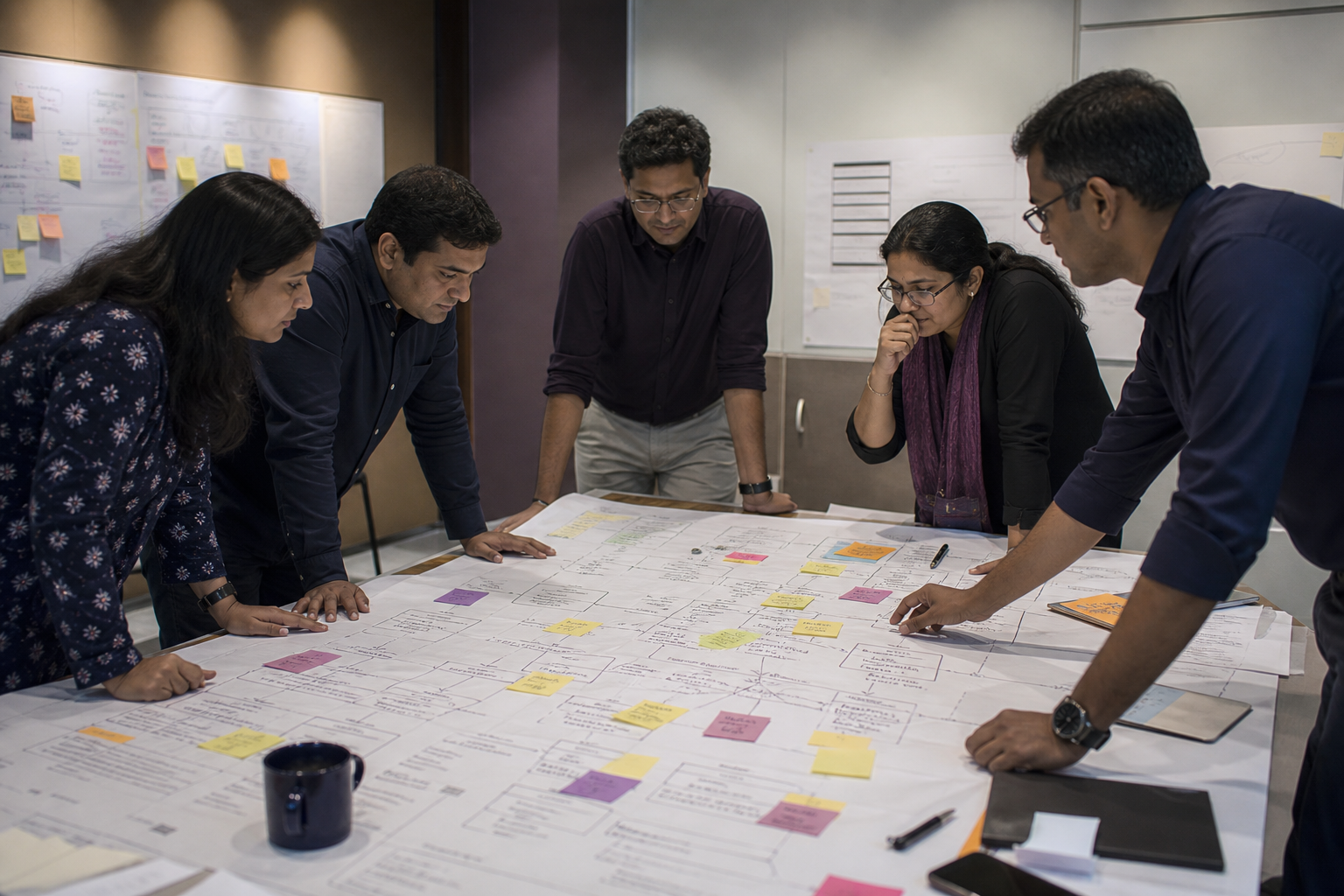
Tell us the business problem. ATRISI maps the opportunity.
Opportunity Discovery is a consultant-reviewed problem-to-opportunity map—not a self-serve maturity score or an academic entry rung.
- Point 1: Problem-led discovery
- Point 2: Enterprise contract
- Point 3: Starting point for pilots
Who it serves
For owners installing organizational intelligence infrastructure.
CTO, CIO, data, product, engineering, and transformation leaders bring real operating problems. Vertical context is used as assessment packs, not invented public domain frameworks.
- Point 1: Technology leadership
- Point 2: Operating-model owners
- Point 3: Institutional operations
Engagement ladder
Discover, assess, audit, pilot, then scale with evidence.
Opportunity Discovery → Intelligence Assessment → Intelligence Audit → Pilot Sprint → Enterprise Academy → Scale.
- Point 1: Primary shipping path
- Point 2: Packaging stays explicit
- Point 3: No guaranteed ROI
From discovery to pilots
Each stage has a distinct job.
Discovery maps the surface; assessment reads readiness; audit structures gaps; a time-boxed pilot produces artifacts and operating-model learning.
- Point 1: People, process, systems
- Point 2: Intervention options
- Point 3: Evidence—not slides alone
PBAR fit
Every engagement should strengthen reusable capability.
Product operationalizes outcomes; Process enables learning; Policy governs adoption; Pattern makes structures reusable across contexts.
- Point 1: Product · Process
- Point 2: Policy · Pattern
- Point 3: Research-to-model loop
Evidence and reporting
Activity is not automatically transformation.
Opportunity maps, readiness responses, audit findings, deployed artifacts, workflow changes, and iteration logs retain observed, derived, inferred, or editorial claim levels.
- Point 1: Problem evidence
- Point 2: Readiness evidence
- Point 3: Pilot evidence
Platforms in the loop
Platforms operationalize frameworks; they do not own the thesis.
TWAI supports operational signals, JoaLLM the institutional intelligence layer, and Kamgrove the deployment bridge—in development. Frameworks remain platform-independent.
- Point 1: TWAI · operational
- Point 2: JoaLLM · strategic
- Point 3: Kamgrove · In Development
Academic bridge
Talent and applied research connect the paths without collapsing them.
Amplify and Campus-to-Career may feed enterprise problem-solving, while industry problems generate applied research. ANSE is not nested in the academic ladder.
- Point 1: Talent pathways
- Point 2: Applied research
- Point 3: C2C remains academic entry
How engagement starts
Begin with the problem, then earn the scale decision.
Discovery conversation → Opportunity Discovery design → assessment or audit → Pilot Sprint → evidence review and scale decision. Pricing stays in direct programme flows.
- Point 1: No invented fee table
- Point 2: Observable pilot artifacts
- Point 3: Collaborative scale decision
Compact glossary
Shared language for this guide
- ANSE
- AI-Native Systems Engineering
- OD
- Opportunity Discovery
- PBAR
- Platform-Based Applied Research
- AITF
- ATRISI Institution Transformation Framework
- JoaLLM / TWAI
- intelligence platforms
Next conversation
Start with Opportunity Discovery.
Bring the problem, stakeholders, operating context, and evidence questions that matter.
Continue the conversationKrishna · Point of Contact
+91 77953 67212 · analyst@atrisi.org